











 |
 |
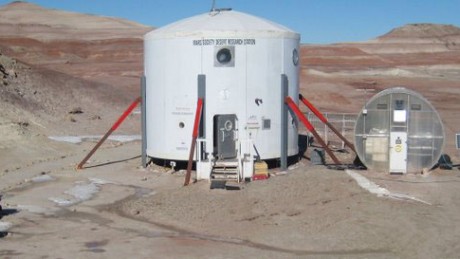
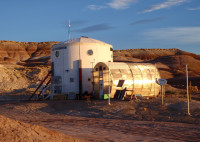
Mars Desert Research Station in Utah
(crew137.net)
In early February 2014 will mostly Czech crew, named Crew 135, goes to Mars.
No, it’s not sci-fi. The six-member crew (four of them are Czechs) is going to go to Mars Desert Research Station in Utah, USA, to simulate a fourteen days long stay on Mars.
Already the environment of the Utah’s desert evokes feeling of surface of Mars – Low temperature in conjunction with the outside, red – colored terrain. The goal of the simulation is primarily to see, what will the stay on Mars under difficult conditions during sand storm be like.
The crew consists of six daredevils: Tereza Pultarová, Ondřej Doule, Filip Koubek, Martin Kubíček, Lucie Polet and Elif Oguz. Their mission shall begin on the 1st February. You can follow the progress of the mission on twitter @MDRS_Crew135.
Tereza Pultarová shared her feelings and oppinions about the mission in attached interview. It is really worth it and we recomend to read it.
Wish Tereza and her colleagues good luck!
1. Please explain, what your „martian“ expedition is and what is its purpose.
Our group , the crew of 135, which will in February 2014 spend two weeks at the Mars Desert Research Station in Utah, USA, is part of a long-term project, which is sponsored by Mars Society. Mars Society is an international non-profit organization that brings together scientists, engineers and other space enthusiasts from around the world who believe that the human race would soon be sent on Mars and collecting scientific evidences. Mars Society currently has about 4,000 members worldwide.
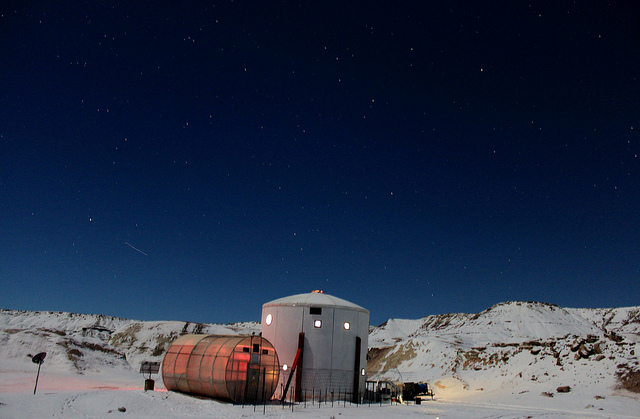
Christmas on Mars
(marssociety.org)
The project aims to maximal authenticity – real-looking base, a six-member crew is isolated from the outside world, which has limited contact with their control center. Like actual mission to Mars and the MDRS crew must perform a research schedule which every team sets itself in coordination with the Mars Society. Also the surrounding environment is very realistic. The station is located in the middle of the area called San Rafael Swell, which is basically like a huge red-colored sandstone formation, so you really feel as on Mars.
The only food available for us, is only the food, that should theoretically survive transport to Mars, it means everything is sterilized, nothing is fresh – if it doesn’t grow in a greenhouse.
The only difference is that unlike on Mars, in Utah we can breathe normally. But crews are tasked to pretend that they can’t, and any movement outside the base must be done in spacesuits with simulated oxygen supply.
Our crew, putted together by architect Ondřej Doule, will focus primarily on the base itself, try to valorize its energy performance and its resistance to extreme environments using computer modeling – for example, few people know that Mars from time to time there is a so-called big sand storms that envelop the entire planet into a huge cloud of sand for a few weeks – a real crew during that time will not have contact with the control center, solar panels won’t work, dust particles carried by strong winds will threaten to damage all the external structures of the base. And it is definitely something that needs to be properly studied before the people will do a real Mars expedition
2. How did you joined the project ?
Our crew was putted together by Ondřej Doule, the architect who has been involved in architecture for extreme environments, including outer space (currently operates at Florida Institute of Technology). I worked with Ondřej on a few broadcasts during my activity in the Czech Television and he basically made me a bit more directed to the astronomy. So when he was putting together a crew and he needed a journalist, the choice was me. I took that chance, of course, immediately because I knew it was not just an extraordinary experience, but also a unique filmmaking, documentary and journalistic opportunity.
If you are asking why they have to be simulated crew to Mars journalists and filmmakers, it is quite clear. When you do something like this, you want the world to know about it. Similarly like the Mars Society, which is still looking for public support and trying to inspire more people to get involved in space activities, needs to know the activities of the world – and we need just people, which can topics like science, space and cosmonautics can push in the mass media.
Moreover, until one day will human race fly to Mars, and the world will probably watch it on television or internet, so we’ll try it somewhat dry run.
Except me and Ondra is in the crew also adventure cameraman Filip Koubek, aerospace engineers Martin Kubíček, Lucie Poulet and Elif Oguz. Except of Elif and Lucie, we all are from the Czech Republic, although currently scattered literally around the world, so we say that we are the first Czech expedition to Mars Desert Research Station.
3. What will be the progress like, are you expecting some inconveniences?
One inconvenience unfortunately occurred before departure. Original member of our crew (and inexhaustible source of great ideas) Vratislav Šálený, an engineer from Brno company Sobriety, had for serious family reasons canceld his participation two weeks before departure. This of course disconcerted coordinators of the program. However, one of our alternates – cameraman Filip – managed at the last minute to hop on the train. Vratislav will support us remotely and help us with computer calculations. Basically we will pretend that his lander broke down and he’s remained in the orbit of Mars, where he helps the crew in the field.
I hope that we have exhausted our dose of trouble. 31st January evening, we all from different parts of the world will gather in Grand Junction, Colorado, from where will we go in the early morning of 1 February by car to Utah. There the previous crew from our station will initiates us into all the technical issues.
The only thing, that I’m a bit afraid of in the first days, is a dealing with jet lag. And then we’ll see what will the Martian diet with absence of fresh fruits and vegetables do with us.
4. How would you rate the level of risk in the experiment?
Mars Desert Research Station has been operating for over ten years. Members of the crew are expected to be adult and intelligent people capable of following the regulations. At least one of the crew had to go through first aid courses for all cases. So I do not think we undergo any real danger, after all, we are still on earth.
5. What do you expect from the mission , what benefit should it have for you and in general?
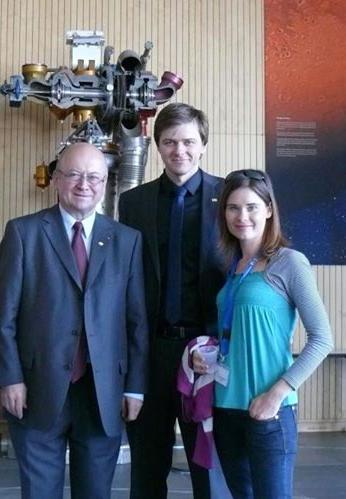
Tereza Pultarová with comander Ondřej Doule and Czech astronaut Vladimír Remek
(Tereza Pultarová’s archiv)
As for the general benefit, I believe that projects of this type, besides helping to collect important scientific knowledge in various spheres of human life, can help inspire others. Each of us was in his/her life influenced, inspired or directed by someone, and we can help inspire and direct others – to not to look only from a distance, but to actually participate in international space and scientific activities.
6. Do you take some talisman with you? A souvenir thing ?
I admit that I’m not.
7. What exactly is your opinion of the piloted space flights? Does it make sense to you to support it?
And why not? Piloted space flights will always be a flagship of space research and plays a special role in many ways. Although robotics move forward at an incredible pace, qualified human researcher in most roles still much more effective.
In addition, man will always want to experience things for themselves and the human body in space itself is extremely interesting object of study for biologists and physicians. For example, bones of astronauts in weightless condition are getting thinner, like old peoples bones, so research on astronauts may have implications for millions of people around the world. To keep a person alive and well in the universe requires the interplay of many scientific and engineering disciplines. Need to tweak to perfection information technologies, nutrition, physiotherapy, recycling of oxygen, water and bio-waste. All these knowledge can be used also on Earth.
Although the robotic rover Curiosity became a world celebrity in its own way, the human element has undoubtedly much greater effect. For example, the generation that lived through the landing on the moon, has a much greater interest in aerospace, science and technology than the generation which came later. So piloted space travel has certainly enormous potential to inspire people to focus on those disciplines that move the world forward and seek solutions to existing problems.
8. What mission on Mars, what do you think will it bring to the „ordinary people“?
It depends on what you mean by „ordinary people“, all points from the previous answers will certainly be applied also to this question. Journey to Mars is a great dream of generations of enthusiasts, scientists and engineers. If this will someday happen, it will actually fulfilled the dream of part of humankind. Maybe it can inspire even the most „ordinary people“ that when they will really try to achieve something and not to sit all day drinking beer and watching TV, so they’ll do so at the end – when mankind can get to Mars, then more modest goals must really be almost within reach.
9. You are known as a popularizer of science. What do you see its perspective in the coming years and decades? Will the perception of it change according to you?
Scientific knowledge and its application in practical situations push the world forward, so from a global perspective, I’m not afraid of science. Look how the world has changed in the last fifteen years – We are all connected to the global network, we have communication capabilities, what the generations before us never dreamed of, and it’s all thanks to science. Just try to imagine how would be this interview made fifteen years ago – I’m in London, you’re in the Czech Republic. It would probably be very expensive call.
If you mean the perception of science in Czech society, I hope that projects like ours can inspire today’s children to focus on the scientific and technical disciplines.
One of the things that I realized at the time I was working on scientific programs with Czech television, it’s a huge international interconnection of science. All major scientific projects of our time have international participation, and the people from Czech Republic can through science belong in the world and often they do. Scientists have opened doors to the world in the form of internships and participation in the project, they must be in daily contact with their international partners. In what other discipline would you find such an opportunity to integrate and be part of the most fascinating things that man kind work on?
Source: rar2mars.net, marssociety.org
Přečtěte si také:
Stránka: 1 2

 Vyplňte prosím dotazník o používaném softwaru a dejte nám tak vědět, jaký je váš oblíbený software!
 Microsoft odebral CERNu status akademické instituce. Proč se tak stalo? Změnil Microsoft licenční podmínky? Hrozí něco podobného i českým ústavům?

 Loading tweets...